
Enoura Observatory in Odawara

All my friends told me I should run—not walk—to see the Enoura Observatory. Not one of them could quite explain why. Or even really describe what it was. Once I was there, though, I understood. It’s such an immersive and utterly visual experience, trying to explain it in words is like describing color to a blind person. (I am, of course, going to try, with the help of a few photos that will also not do it justice!)
This diabolically designed and artfully landscaped cliffside outside Odawara is the brainchild of Hiroshi Sugimoto, a venerable Japanese artist whose mediums are photography and architecture. If you’re not familiar with his work, check out his water/horizon/sky photos, because Sugimoto’s “Seascape” series sets the stage for the 3-D (and immensely more colorful) site he envisioned thirty years later:

Are you ready to try not to be impressed? Let’s start at the gate, and stroll past an rock garden that manages to be both ancient and modern at the same time.

It perfectly sets the mood for what lies beyond, as we begin to feel the push-pull of old vs. new, ritual vs. natural, and enclosed spaces vs. wide open vistas, all seen through the lens of Sugimoto’s uniquely Japanese design sense.
As we make our way toward the long building ahead, we cross our first tantalizing side path. Ah. The Enoura Observatory is going to be a big Japanese garden, with the ocean as its far wall. Good guess. And not wrong, but…let’s push on.
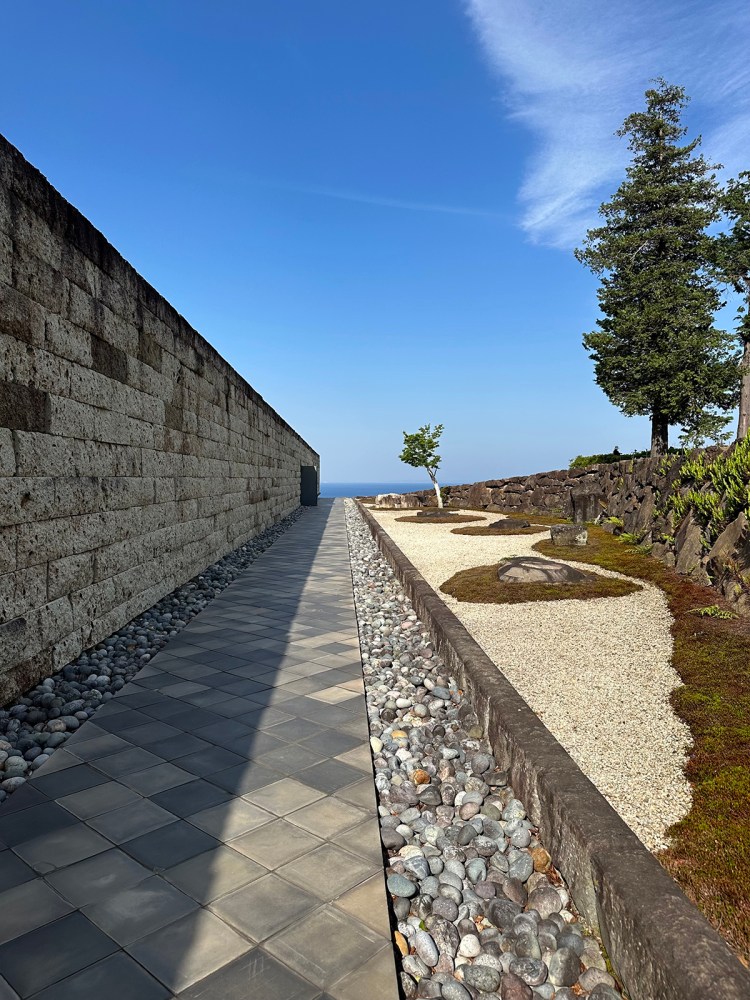
We might be tempted to enter this building first (it’s nearly impossible to resist), lured in by Sugimoto’s works or the magnificent view from the balcony at the end. But that would be a mistake.

Because the real Enoura experience meanders around the gallery and down the hill…
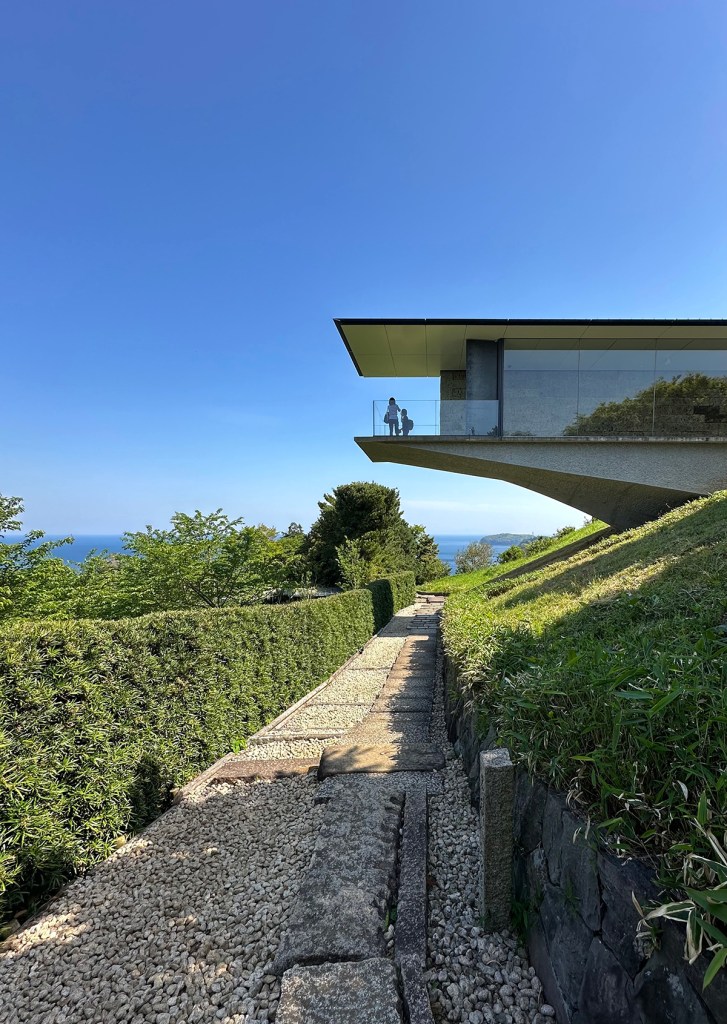
branching to the left onto a steeper downhill path. It leads to a stone-lined courtyard with an entrance to this.

No surprise (from an architect who’s famous for his photographs), this long, dark tunnel is all about light. The open-air skylight halfway through creates a well of brilliance on sunny days and a hushed soundscape of falling water on rainy ones. Looking back toward the entrance, we see that the tunnel doorway frames a stone. This one is illuminated on the winter solstice…
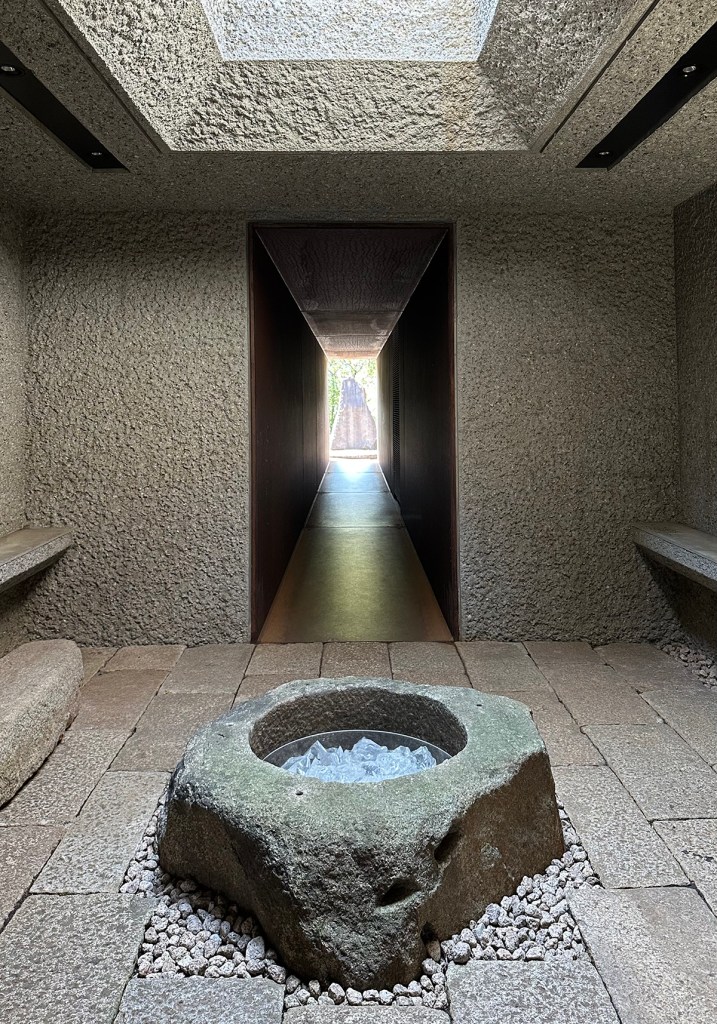
because this tunnel is precisely aligned with the point on the horizon where the sun rises on the shortest day of the year.
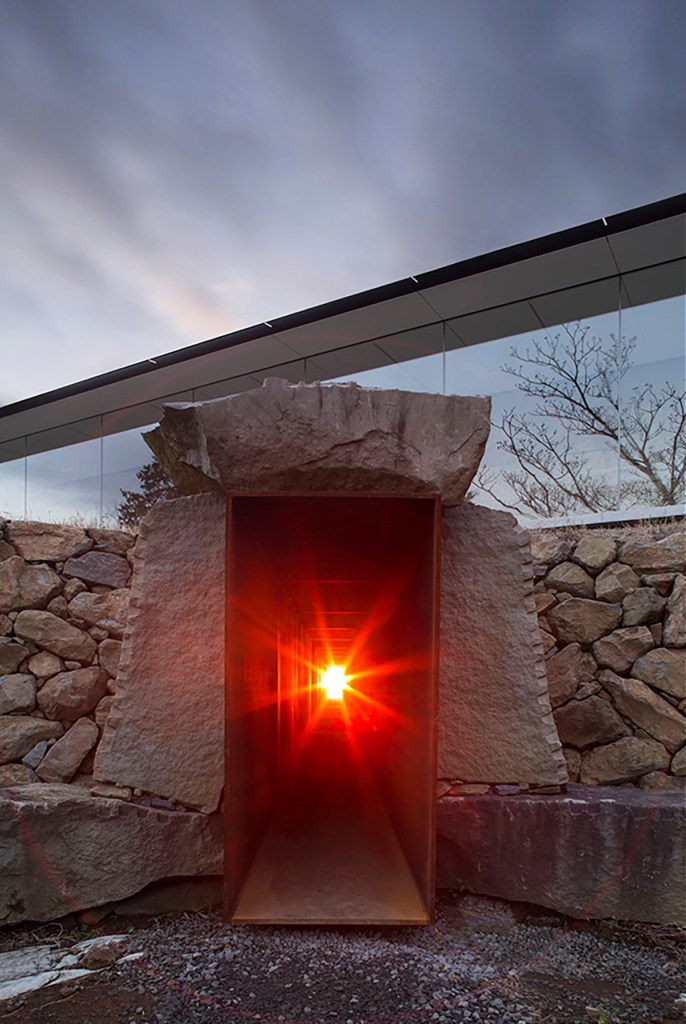
As we push on, the glow at the far end is so bright in contrast to the absolute darkness of the tunnel, it’s hard to see what awaits us…
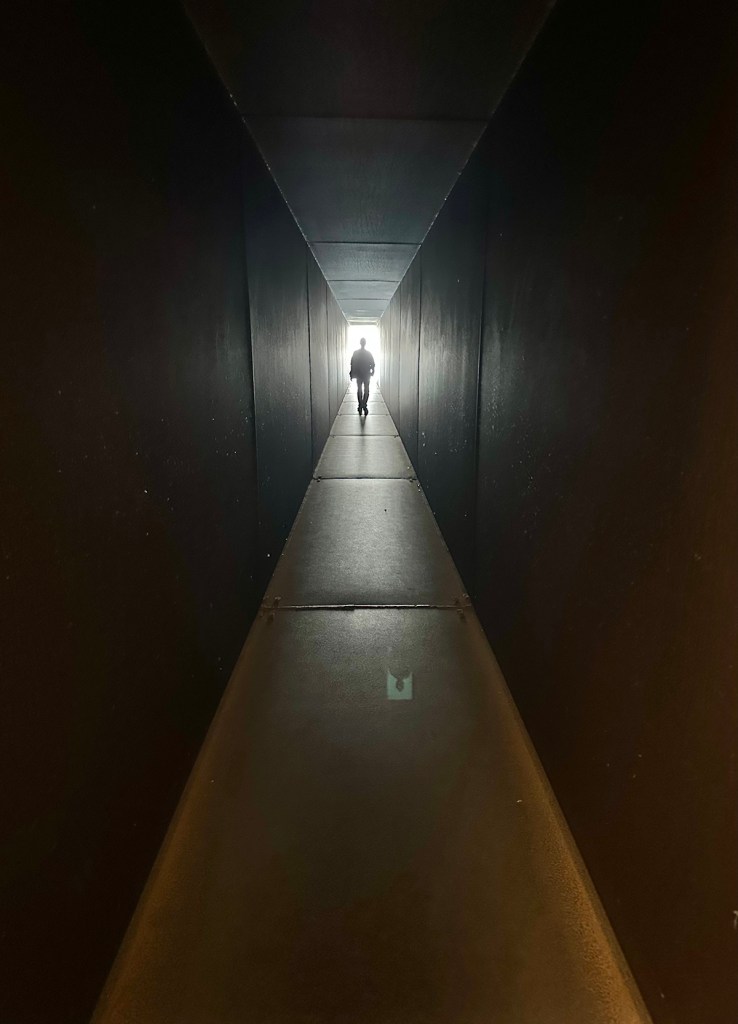
but we’re not 100% surprised to emerge into another beautifully composed landscape that’s a crossroads of tempting choices.
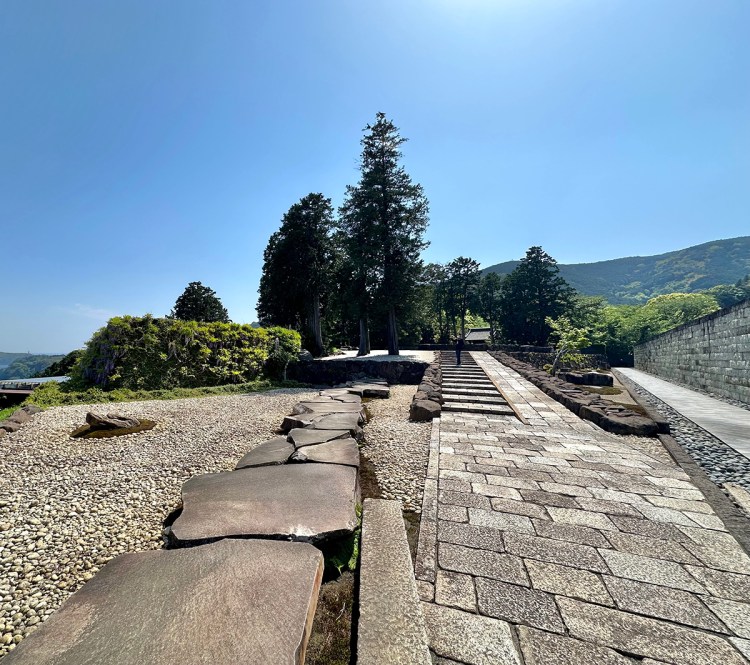
Like TeamLab Borderless, the Enoura Observatory is designed to be best experienced by following your senses—not consulting a map— but let’s choose not to move on to the dry garden beckoning from the top of the hill because we know the steppingstones on the left lead to the second half of the tunnel. Let’s dive through the wall of wisteria to find out where it goes.
Just inside, we’re momentarily fooled into thinking there’s an unmarked tunnel branching off to our right, but it turns out the “doorway” is actually a mirror. It’s the Enoura Observatory’s first subtle lesson in expecting one thing and discovering something else.

As we get to the corridor’s end, it becomes more and more apparent that the rusty “road” ahead isn’t a path…

it’s a plank. And even though it’s obviously made of iron and extremely solid and not even especially narrow…
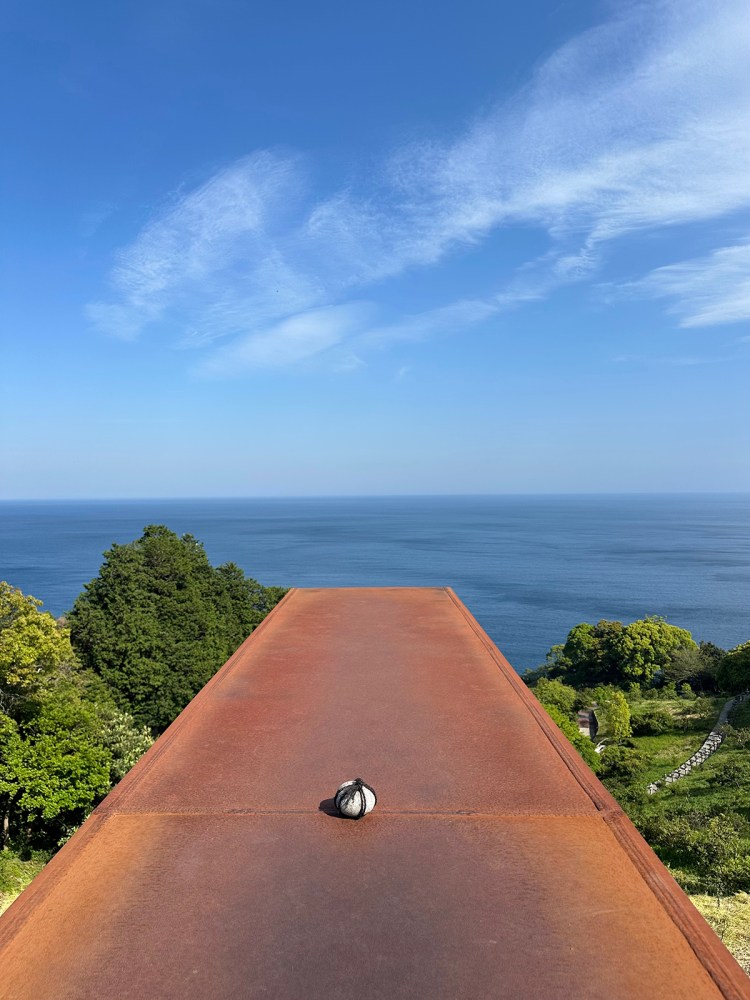
venturing out onto it still evokes a little gasp of fear and astonishment at being suddenly surrounded by nothing but air and the stunning view all around.
Once we’re back on solid ground, let’s go see the dry garden up above, which features a stone stage for outdoor performances and a collection of ancient artifacts that don’t just play a role in the garden design, they’re pretty interesting in their own right.

Out the other side, let’s follow the trail down toward the bamboo grove, through garden grottos and past a teahouse inspired by Sen-no-Rikyu’s “Tai-an” tea hut. It’s got a killer glass sculpture on the doorstep, and a primitive stone torii gate at the entrance…

that definitely gives off Stonehenge vibes.

Below the teahouse, there’s a magnificent old-growth nurse log festooned with a sacred shimenawa rope. It’s enshrined outside a structure housing a collection I definitely did not expect…

the Fossil Cave!

Extremely choice fossils, too. While I was there, every single visitor asked the docent, “Is that real?” (The answer is yes.) I’ve never seen fossils this crisp and magnificent, even in a museum. It would, of course, be wrong to touch them, but it’s okay to get pretty close, and was kind of a thrill not to have any glass between me and all the prehistoric goodness.

After appreciating the other intriguing art installations surrounding the Cave, let’s keep going down the steps to the bamboo grove. (And FYI, the photo below is pretty typical of the terrain at the Enoura Observatory. The paths and trails are built to be as gentle as possible and are beautifully maintained, but the site spreads out over 60 square kilometers, so the Enoura Observatory experience is more like a hilly ramble than a museum stroll.

The additional loop is well worth it—just below, the Jurassic gives way to the ultra-tech.
This thing gets more amazing the longer you look at it. The piece tapers to an impossible thin point, and sits on a base of optical glass that focuses the surrounding landscape into bands of brilliant color that change with the light and the angle you view it.

When we finally tear ourselves away and return to the road more traveled, a row of impressive stone lanterns leads us toward a brightly colored something on the next hillside…

It’s a branch of the famous Kasuga Shrine in Nara, and enshrines a deity that’s still visited by an annual festival pilgrimage. You can look down the stone well in front to get a glimpse deep into the earth and the water far below.

After we pay our respects and loop back up to the main buildings, it would be wrong not to stop and envy those shrine gods for getting themselves ensconced in such a gorgeous place!

On the way back up, we encounter the rusty “plank” again—this time from below—and see that it’s actually a hollow beam extending into the air (behind that bush). The optical glass-floored stage at the foot of the amphitheater next to it glows and seems to hover in the air when the sunrise strikes the edge on the winter solstice. Special performances take advantage of that magical moment every year.
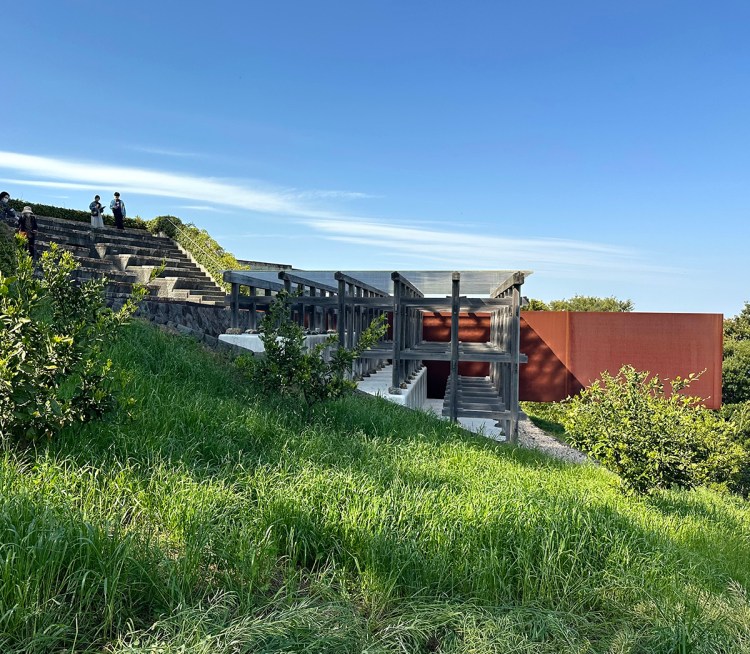
These are just a sampling of the installations and artifacts at Enoura, and there are plenty more delights everywhere you look.
This tanuki’s attitude made me laugh.

But other artifacts deliver deeper feelings. The stone pillar base in this serene garden, for example, was rescued from Hiroshima after the atomic bomb. It’s still a little radioactive.

And this roadside “Jizo” figure is properly Buddhist in front, but a carved cross turns the back into a shrine where those who remained secretly Christian could offer a prayer in the days when outside religions were forbidden by the shōgun.

The figure in the small shrine near the entrance (that I almost missed) is actually a Buddha made by the itinerant monk Enku in the 1600s. He’s famous for carving over 120,000 rustic statues, which he gave to all the temples that welcomed him on his pilgrimages throughout Japan.

The Enoura Observatory is the kind of place that’s well worth visiting even if you breeze through in an hour to appreciate the grand vistas. But it truly rewards those who take the time to double back and pay attention to the little things. It’s the kind of place where the closer you look and the more angles you consider, the more thought-provoking it becomes.

Before we go, let’s visit those gallery buildings and see how much more we appreciate Sugimoto’s photographs and that amazing view of the ocean!
It’s great to see Enoura on a sunny day with a clear blue sky, but I already have plans to go again in different seasons and in different weather, because the experience is never the same twice. I hear some parts of it are even better in the rain or fog.
And if we’re really lucky, someday we’ll see it on the winter solstice when the sunrise lines up with that long tunnel…or on the summer solstice, when the sunrise shines straight down the long gallery in the building near the entrance, illuminating Hiroshi Sugimoto’s original work.

Enoura Observatory (it’s pronounced Enno-oorah)
Open: Every day except closed Tuesdays and Wednesdays. There may be other special closed days, but you can check for those on the website access page when you book your tickets
Hours: Morning admission 10:00 – 13:00; Afternoon admission 13:30 – 16:00; Evening admission (only in August) 16:30 – 19:00
Admission: Adults ¥3300 (no admission for children under 12 for safety reasons)
Buying tickets online in advance is a must, and they don’t go on sale until two months before the visit date. One of the things that makes Enoura such an incredible experience is that they severely limit how many people they let in each day. Every visitor must either book a seat on the free shuttle from Nebukawa Station or reserve one of the very limited parking spaces at the time they buy their ticket.
The online process is well-designed and in English, and they do take foreign credit cards. Be prepared to choose:
1) The date you’d like to go
2) Whether you want to come in the morning or afternoon
3) Whether you need a seat on the free shuttlebus or a parking space reservation.
Once you buy, ticket sales are final. You can’t change the tickets in any way or get a refund, so be very sure before you commit. It pays to have a second, third and fourth choice of timeslots, because they let in so few people, they often sell out. (Which is also why it’s a good idea to do it as far in advance as possible.) The email confirmation will be your admission ticket for your whole group, which they check at the gate against a guest list before they let you in.
Here’s the ticket purchase page.
•
Here’s where the Enoura Observatory is:

And here’s a closer look:

Getting there: Enoura Observatory’s closest train station (Nebukawa) is about a 1.5-2 hour train ride from Tokyo. The Enoura Observatory ticket reservation page lists the free shuttle bus departure times from Nebukawa Station as 9:45, 10:05 and 10:35 for morning admissions and 13:15, 13:40 and 14:00 for afternoon admissions. Once you’re there, you can stay as long as you like. The shuttle bus leaves Enoura to go back to Nebukawa Station at 11:30, 12:00, 12:30, 13:00; 15:00, 15:30, 16:00, and 16:30.
To figure out how to get to Enoura Observatory from where you are, use the Japan Navigation phone app, plugging in your location, travel date and preferred arrival/departure time. Here’s where to get the app and how to use it.
•
Click here for more Beyond Tokyo posts

•
Or get more must-see destinations sent to your email every month when you subscribe!

•

•
•

Jonelle Patrick writes novels set in Japan, produces the monthly Japanagram newsletter, and blogs at Only In Japan and The Tokyo Guide I Wish I’d Had
 Japanagram
WOW, WOW, WOW. Enoura, what an extraordinary experience. That looks AHHmazing. Your pictures were exquisite. Ever consider approaching PBS with your travel blogs?
LikeLiked by 1 person
I’m so happy that you enjoyed riding along to Enoura! But ahahaha, I can barely keep my head above water writing the blogs and books——I’m afraid trying to expand into another sphere (even the fabulous world of PBS) is beyond my limited abilities! Honored you think the material PBS-worthy, though! You’re the sweetest.
LikeLike
Hey Jonelle! Gosh, it’s taken me ages to get around to checking out this post and as it turns out I picked a perfect moment. It’s a lovely day here in Hawaii but I’m also feeling a wee bit homesick for Nippon and both the photos and your descriptions bring this magical place to life. If and when we finally make it back there, we’ll definitely visit. Thanks for sharing such an extraordinary experience.
LikeLike
Waah, your message made me so happy, and I hope you do get back to Japan soon, so you can see this amazing place! Even though you live in the most enviable place on earth (and I’ll never forget the fortitude with which you upped stakes and got yourselves there!) Enoura has the kind of beauty I think would resonate deeply with you. It’s SOOOOO Japanese in so many ways that are easily missed by those who never lived in Japan, and although anyone can appreciate how lovely it is, understanding the underlying ideas makes it that much better!
LikeLike