
Robert Hass reveals the secrets of translating haiku into English
Think about it. Writing a haiku is already a daunting task. With only seventeen syllables to convey a whole season, a deep insight about the universe or the nature of human existence (plus a dose of aha!) there are only a handful of masters who managed to write decent poems, let alone haiku that have stood the test of time and are as widely read today as they were when they were written. Each Japanese word has to be carefully chosen and work in several different ways in order to accomplish this Herculean task.
Now, translate all that into another language.

So…how do you translate the impossible?
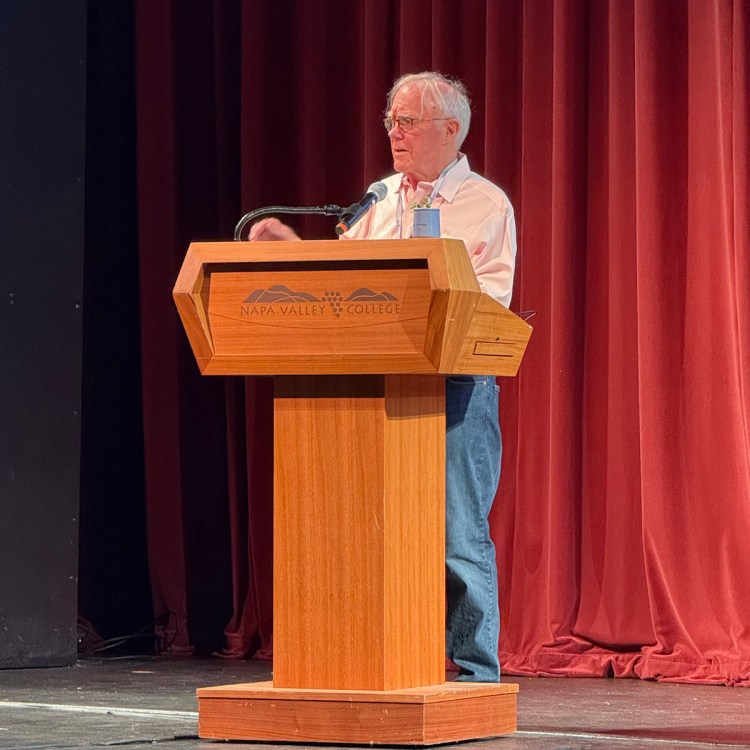
For the answer to that, I had the great good fortune of asking the single greatest living translator of haiku on the planet, my literary hero Robert Hass! When I saw that the two-time US Poet Laureate was teaching a unit on poetry translation at the Napa Valley Writer’s Conference this past summer: TAKE MY MONEY.
And he did not disappoint. I learned something surprising in the very first minute of his keynote address: he’s not just master of Japanese poetry translation. He has also translated works from Chinese, Polish, Croatian, and German (just to name a few!)
Even though he doesn’t speak any of those languages.
Wait, WHAT?
The way he does it, he explained, is that first, he identifies a poet he wants to share with other English-speakers. Then he goes out and buys several English-to-whatever-language-they-write-in dictionaries, and a few editions of the poet’s works, both in their native form and in translation (if any exist).
Then he begins to noodle. When he’s finally chosen the poems, he approaches each one in several different ways, then steps back and looks them all over, choosing the one his poet spidey-sense tells him is the closest to the original poet’s intended meaning.
Which still left me with the burning question: how does he pick the winners?
After his lecture I scampered over and shamelessly introduced myself, trying not to fangirl all over him (I can neither confirm nor deny that a courage-boosting glass of wine was involved). And asked him how he chooses The One True Translation.
He said oh, really it’s just my own best guess (leaving modestly unsaid that he is one of the world’s greatest living poets himself, and great poets can winkle out more layers and greater meaning than the average run-of-the-mill verse-slinger because they do it so successfully in their own work).
But, he admitted, he does have a secret weapon.
In his long tenure at UC Berkeley, he has made many friends, some of whom are sure to be native speakers of the very language he’s translating. So he invites one or two of them over for a congenial session and shows him the original poems, then his various translations. They chew it over together, and his friends supply not just technical nitpicks, but cultural insights into why one choice of words might be better than the others.
And there you have it. What’s the key to being the best poetry translator in the world?
1) Be one of the world’s best poets yourownself
2) Make friends from all over the world.
(I’m never going to master #1, but the second is something we can all aspire to!)
•
Click here for more The Thing I Learned Today posts

•
Or get more amusing Japan stuff sent to your email every month when you subscribe!

•


Jonelle Patrick writes novels set in Japan, and blogs at Only In Japan and The Tokyo Guide I Wish I’d Had
 Japanagram